Cloud Infrastructure
Server Infrastructure Evolution: Moving from Monolithic Virtual Machines to Orchestrated Containers
How migrating to an immutable infrastructure with Docker and Kubernetes revolutionized our service delivery, resilience, and deployment velocity.
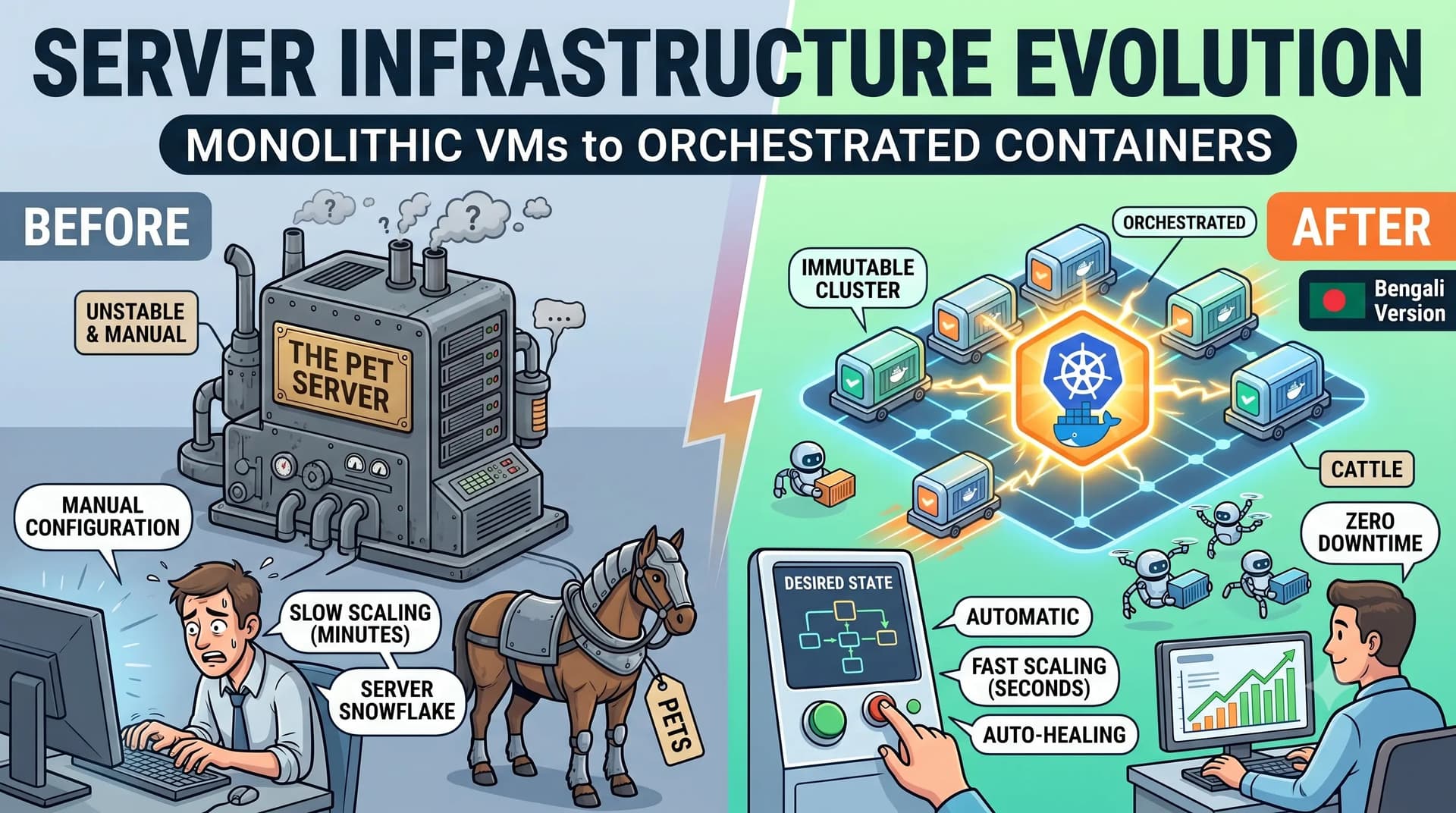
In the previous decade, the industry standard for hosting applications was managing a fixed fleet of long-lived Virtual Machines (VMs). I used to spend hours manually configuring each server, applying patches, and handling unpredictable downtime. This model created "server snowflake"—systems so unique that recreating them was nearly impossible.
To achieve true scalability and resilience for a portfolio of modern high-traffic applications, I made a decisive shift. I moved away from managing individual servers and adopted an Orchestrated Container Infrastructure. Here is how that transition transformed our operations.
1. The Monolithic Pain: Manual and Pet Servers
Our old infrastructure treated servers like "pets": we gave them names, we nursed them back to health when sick, and their death was a catastrophe. Managing dependencies across different VMs was a nightmare, and scaling meant cloning large, resource-heavy operating systems, which took minutes and wasted hardware.
The "Before" diagram on the left illustrates this: a single, stressed operator trying to manage an inefficient, vertically stacked pile of resources prone to single points of failure.
2. The Orchestrated Future: Immutable Clusters
Moving to containers changed everything. We adopted a "cattle" approach: servers are anonymous, and if one is sick, we simply replace it automatically. We packaged our applications using Docker, ensuring identical runtime environments from local development to production.
The real breakthrough came with Kubernetes to orchestrate these containers across a unified cluster of nodes. Instead of managing servers, I now manage a desired state for the entire cluster.
Here is how a Kubernetes deployment manifest defines this:
YAML
apiVersion: apps/v1
kind: Deployment
metadata:
name: dynamic-web-app
spec:
replicas: 5 # Desired count of app instances
selector:
matchLabels:
app: web
template:
metadata:
labels:
app: web
spec:
containers:
- name: web
image: custom-repo/dynamic-web-app:v2.1
ports:
- containerPort: 8080
The Result
The "After" diagram on the right shows the new landscape: a streamlined, automated cluster. Scaling from 1 instance to 10 instances now takes seconds instead of minutes. If a physical node fails, Kubernetes instantly moves the running containers to a healthy node, achieving true self-healing and zero downtime. This modern infrastructure is efficient, fast, and optimized for constant delivery.